

Written by Stuart Simmonds – VP Business Development & Marketing
March 27, 2026
What you’ll learn from this article:
- Why process analyzers still require structured care despite industrial design improvements
- How routine and preventative maintenance contribute to measurement integrity
- The role of field service expertise in sustaining analyzer performance
- Why localized technical support influences uptime and response effectiveness
- How maintenance planning helps extend analyzer lifecycle
Maintenance as a performance strategy.
Routine maintenance remains one of the most effective ways to protect analyzer reliability. Activities such as inspecting sampling components, verifying analyzer response, and performing calibration checks help identify degradation before it affects plant operation.
Predictive and preventative maintenance approaches can further reduce unexpected downtime. By monitoring performance trends and scheduling interventions in advance, plants can avoid emergency repairs and stabilize maintenance workload.
Functional testing also plays an important role. Confirming analyzer response under known conditions allows teams to distinguish between instrument issues and process-related changes. This reduces unnecessary troubleshooting and improves confidence in measurement data.
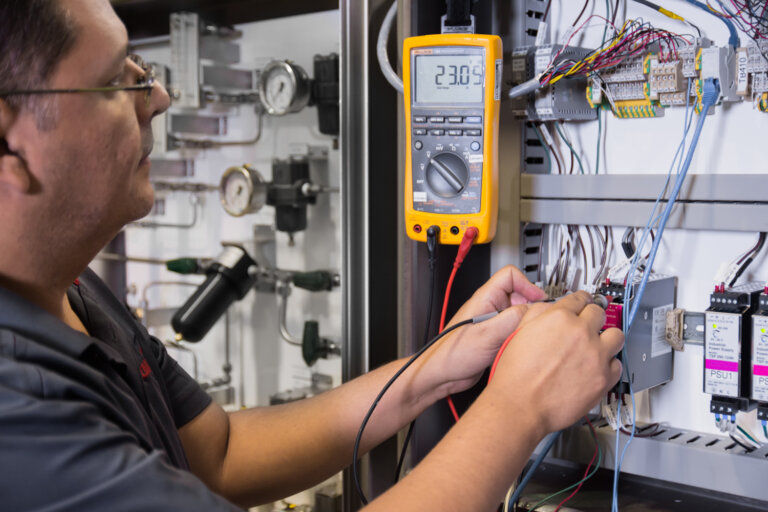
Verifying analyzer response and electrical signals during maintenance helps confirm whether performance changes are instrument-related or process-driven.
The importance of field knowledge.
Process analyzers are not standalone instruments. Their performance depends on the behaviour of the sampling system, the characteristics of the process stream, and the way maintenance is carried out over time.
Service technicians who regularly work on analyzers develop practical insight into these interactions. Their ability to diagnose sampling issues, adjust maintenance practices, and provide targeted training contributes significantly to the overall health of the analyzer fleet.
On-site expertise is particularly valuable during commissioning, process changes, or periods of unstable operation. In these situations, timely technical support can prevent prolonged measurement uncertainty.
Analyzer lifecycle expectations.
It is common for process analyzers to remain in service for 20 to 25 years. Achieving these lifetimes requires a structured relationship between plant teams and field service providers. Regular communication, shared maintenance planning, and ongoing knowledge transfer help maintain instrument performance over extended periods.
Service contracts can support this approach by defining maintenance intervals, ensuring spare parts availability, and providing predictable access to specialist expertise. Plants that adopt preventative service strategies often experience improved uptime and more stable analytical performance.
By comparison, a run-to-failure maintenance philosophy can increase long-term workload. Reactive repairs tend to be more disruptive, require more extensive diagnostics, and may contribute to accelerated component wear.
Local support and operational responsiveness.
When analyzer issues affect production, safety, or compliance, response time becomes critical. Local service capability helps reduce delays associated with troubleshooting, logistics, and technical coordination.
Access to nearby expertise allows maintenance teams to address problems earlier and maintain confidence in analytical measurements. Over time, this responsiveness supports more consistent process control and reduces the likelihood of extended measurement outages.
A practical service mindset.
Sustained analyzer reliability is often the result of consistent field engagement, structured maintenance routines, and collaborative problem solving between plant personnel and service specialists.
This is why service is not treated as a separate activity, but as part of how measurement systems are managed throughout their operational life.
At Novatech, this perspective has shaped how service teams support customers, with an emphasis on practical diagnostics, adaptable training, and long-term measurement reliability.
How are your analyzers being maintained today?
Explore how structured service and preventative maintenance support long-term measurement reliability.
Takeaway.
Process analyzers can provide reliable data for decades when supported by disciplined maintenance practices and accessible technical expertise. Their effective lifespan depends not only on technology selection, but on the consistency of service applied in real operating conditions.
Plants that treat analytical systems as long-term assets tend to achieve higher uptime, stronger measurement confidence, and more stable process performance.
Be the first to read our articles
Written by Stuart Simmonds – VP Business Development & Marketing
Write to Stuart at: stuart.simmonds@novatech.ca
